Showing posts with label Street food. Show all posts

Thursday, November 25, 2010

Lobster truck


I've been trying to have a lobster rolls for weeks now, and last weekend, the Red Hook Lobster Truck just happened to be parked conveniently by Eastern Market, close to the Library of Congress where Keith and I were visiting as part of our adventures on the mall.

Thursday, June 17, 2010

Seattle - Pike Place Market

I just got back from a fantastic trip to Seattle and Portland to visit Jimmy. The trip only confirmed my desire to leave the east coast and live in Pacific Northwest. I just loved the feel of the area with its abundance of amazing foods and coffee, the breathtaking scenery, and the laid back, friendly, and often quirky people. On the trip, most of our time was spent eating or in transit between places to eat, with visiting non-food related sites almost as an afterthought. Our excellent guide, Jimmy, herded us to so many restaurants, coffeeshops, and food karts that by the last meal of the trip I could only handle a small bowl of salad. Everywhere we went, whether it was a small Schnitzel kart run by a Czech couple or a crowded Lebanese restaurant that takes the effort to make fresh pita for every table, I got the sense that people were incredibly passionate about the food they prepared and/or served in a very deep way. As a result, the foods we ate were often quite simple, but because of the thought and care that went into them they turned out to be some of the most delicious things I've ever tasted.


Sunday, October 18, 2009

Philly and its food karts

This particular trip into Philly was inspired by this article from Gourmet. I first got to know the food karts the summer of my sophomore year when I stayed at Swarthmore to do research and Chris was living near the UPenn campus. There was this Halal kart right outside his apartment with excellent fallafels and schwarmas and such. I also visited the Crepe shop in Houston Hall in UPenn which used to be a kart but has since moved on. Since then, I've wanted go back and try more karts. This fall break at Swat provided the perfect opportunity.

From Fall Break 2009

From Fall Break 2009

From Fall Break 2009

A couple friends and I ventured into Philly in the morning for a quick tour of the Franklin Institute. It felt more run down than other museums of a similar nature such as the Boston Museum. Many of its exhibits were out of service. But overall, it was still super fun to do silly things like walk through a ginormous human heart and watch an eye dissection.

From Fall Break 2009

Exercising to improve our heart, health, and mood!
From Fall Break 2009

Jimmy, the chief investigator:
From Fall Break 2009

We walked to 33rd and Market, where there were about 5 karts parked pretty close to each other. As we explored our options, we settled on the strategy of divide and conquer. We got something from three karts: Mikey D's Grill (a hoagie stand), Ton-Ton (Japanese), and La Dominique Crepes.

The pork bento box from Ton-Ton:
From Fall Break 2009

It was a pretty standard Japanese thing, with pork kebabs over rice. The skewer had pork and onion on it and was deep fried. And frankly, I find it hard to dislike fried pork as a genre, so I thought it was pretty good. Their other items on the menu also looked interesting, including rice omelets (Crazy! I guess fritattas are also rice and eggs, but for some reason a rice omelet just seems so odd. Must try it next time), onigiri (rice balls), and pork dumplings.

I got a veal stew crepe from La Dominique, and it was SO DELICIOUS. First of all, the stew itself was just amazing. It was flavorful, rich, and dotted with vegetables. The guy must have made it at home and brought it over because it definitely tasted homemade. And I hate to say this in case it makes it sound any less good than it actually was, but the stew almost tasted like it was not made that day, like leftovers. But you know how soups and stews always taste better after a day or two after the flavors had melded. Well, it was like that, in the best possible way.

And once the stew's wrapped in the crepe, he topped it with a light salsa of cilantro, which made the entire thing. The taste of cilantro lightened the whole dish and gave it a citrus kick. It was fantastic. Who knew that stews can go in crepes and be so fantastic?
From Fall Break 2009

From Fall Break 2009

From Fall Break 2009

From Mikey's we got a chicken and prosciutto hoagie, heavily flavored with balsamic vinegar. Sounds odd, for sure, but it was actually pretty fantastic. The chicken was tender and the prosciutto added a lot of flavor. The only complaint here was that there was not enough cheese.
From Fall Break 2009

We also got a lemon crepe from La Dominique, which had lemon juice, powdered sugar, and lemon zest on it. Simple and delicious. We passed it around the table but I was lucky enough to get the last bite, which was pretty much drenched in lemony, sugary goodness.
From Fall Break 2009

Thursday, October 15, 2009

Wursts

This blog is terribly, terribly out of date. Which goes to show just how unstressed I've been this semester. I've mentioned before that it's only when I have something big due and need a lot of procrastination to keep me going do I update this blog. And now, finally, while working on a Spanish essay, do I decide to finish up my three-part series on Austrian food. I know, I know... That was MAY. How dare I talk about something I've had a whole five months ago?? Well, because they're too good to not mention. And once I'm done with this, I can fiiinally write about my trip to China the next time I have a paper due.

Anyway, traveling Austria was super fun, but it was also the most expensive week I've spent anywhere, I think. Maybe it's just because I had to pay for the whole trip myself, but I really think the amount of money spent per day for that week was higher than any other trip I've done. Sure, the flights to Asian may be marginally more expensive, but once you're there, the accommodations are pretty cheap (or free! Gotta love family) and the food even cheaper. But I swear, I spent almost another round trip flight's worth of money on food and lodgings for a week in Austria. Pretty terrifying. But who can turn down delicious food and tortes?

The cheapest meals Chris and I had in Austria took the form of sausages (2-3 Euros per delicious meal? Count me in!). When we were in Innsbruck, there was a wurstkart parked in the middle of the touristy square, next to the golden roof.

From Austria


From Austria


There was a huge crowd of tourists ordering in every language imaginable. Naturally, Chris and I joined the crowd of tourists and ordered from their huge selection of sausages.

From Austria


Chris ordered a St. Johannes, which looked like any old sausage, except it was super long and skinny (coincidence that Chris ordered that one?).

From Austria


I got a weisswurst, which is literally a white sausage. The reason it's white is that it doesn't have the nitrite preservative. Because of this, it's usually eaten as a mid-morning snack and never left for later in the day. Apparently it can be so liquidy that the traditional way of eating it is to open the sausage and suck the meat out of its casing. That was not the state of the sausage that I got, thankfully, but it was way more tender than any other sausage I've had before. Inside, you can see small flecks of herbs and spices that its made with.

From Austria


The interesting thing about buying wursts in Austria is that they're usually not served on a bun, like hot dogs, but are given to you cut up on a plate with a squirt of mustard and a thick slice of brown bread. The brown bread is a much better accompaniment to the sausage given its heartiness, as opposed to the flimsy and blank white bread buns.

After we got back to Vienna, I went looking for another wurstkart, and ordered Hungerwurst (Hungarian sausage), which was spicy and bright red from the paprika. Also very delicious.

From Austria

Tuesday, September 30, 2008

Yangshuo food pt. 2 - dragon beard noodles

Having to write a lab report really is the best way for keeping up with a blog. This must be why I so rarely updated this summer.

From Yangshuo
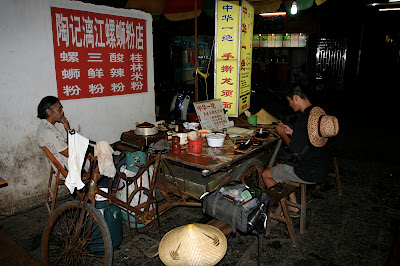
In a small corner of Yangshuo, where tourists are rare, I encountered something pretty extraordinary. While it definitely wasn't a local food, it's definitely worth blogging about.

Noodles are a HUGE part of Chinese culture. Just to name a few: there are the rice noodles I blogged about last time, the thick chewy noodles cut straight into a boil pot from a blob of dough using a very sharp knife and a quick hand, Lanzhou pulled noodles, thin, transparent cellophane noodles... and then you have dragon beard noodles, something completely in a league of its own.

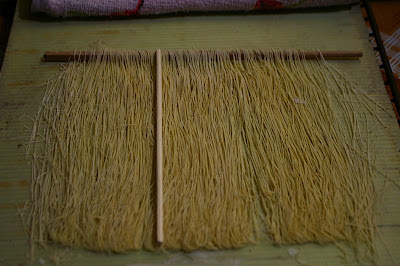
Just imagine: you need to roll out a sheet of dough until it's so thin that if you put it over a book, you can read the text on the page. Then you have to cut this sheet into hundreds of strands, each about a milimeter wide (about 200 knife strokes for a foot of sheet dough). Then you have to find a way to cook these noodles so that they can maintain their delicate shape and texture. If there was ever a dish to eat more for the techniques involved than the actual taste (although I have to admit that they taste exquisite), it's this one. Forget Ferran Adria with his foams and pearls, there is more skill involved in these noodles without any of the flash so typical of famous TV chefs these days.

From Yangshuo

From Yangshuo
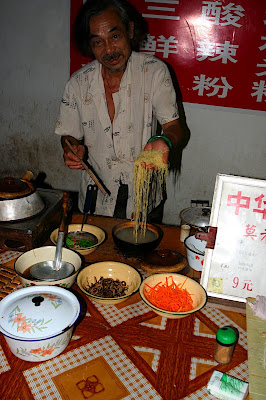
Old Mo cooks these noodles by heating the soup base in a small clay pot until it boils. Then he immediately takes the clay pot off the heat and sticks carrots, mushshrooms, ground pork and noodles in it, cooking all the ingredients with the heat from the soup. The result is light and flavourful. The noodles taste so light with each strand still completely separated and not at all sticking to each other.

From Yangshuo
As we ate, we talked to him about how he is having trouble finding a apprentice to pass on this skill. Old traditional food that is more labor intensive is becoming less popular, especially in touristy areas like Yangshuo. And finding someone who has the talent to make noodles like these can't be easy.

Old' Mo's noodles on Guihua Road in Yangshuo. You'll see him on his makeshift cart after 6pm.

Monday, September 22, 2008

Yangshuo food pt. 1

There is a general rule about food in Northern vs. Southern China. Northern Chinese food is wheat-based (noodles, buns, white doughy mantou, etc) while Southern Chinese food is rice-based. A visit to any countryside farm in the two regions will make this clear. In the north during wheat harvesting season, the fields are golden and not unlike the image I have in my head of Kansas. In the south (oh the magical Southern China), during rice harvest season, you will encounter the most glorious sight of rice paddies extending as far as the eye can see.

But before I go on, let me first give you a sense of your setting. This is the Li river framed by karst formations in Yangshuo, which is an hour away from Guilin.

From Yangshuo


There is a phrase in Chinese that translates into "The mountains and waters of Guilin is the first in the world, but the scenery of Yangshuo beats even Guilin." Maybe a little illogical, but I hope you get the idea.

From Yangshuo

This is only one of the hundreds of rice paddies we passed by. The best thing about them is probably the way the mildly sweet scent of the rice stalks permeated every cubic inch of air in the area. You can't walk by without catching a whiff of it. It smelled like the way a countryside should smell like.

But let's get back to the food.

Rice noodles are the staple food of Guilin and Yangshuo. The locals pretty much eat it for breakfast, lunch, and dinner. They are either prepared in broth or stirfried. And by broth, I don't mean Swanson's chicken broth. I mean the real stock that's been boiled from the bones of beef and/or goat that tastes like how every soup should taste -- hearty, light, and oh so flavorful. We had them mostly for breakfast since there were SO many noodle shops right outside of our hotel.

The way they're usually served up for breakfast is that the shopkeeper would have boiled a HUGE load of noodles beforehand, and all he/she would do is to skillfully get a two or three liang into a metal bowl using a single, long chopstick, ladel some soup into the bowl and ask you to add the rest of the ingredients (garlin, scallions, ginger, pickles...) yourself. Every shops has its specialty and all their soups taste different. You find your favorite and go back every morning.

From Yangshuo

My sister, enjoying a breakfast bowl.

From Yangshuo

One of the days we went to one that specialized in soups with snails. Very enjoyable, although the soup base was quite spicy for so early in the morning.

That was the other thing, when you asked people what shop they recommend for noodles, they would first fire back the question "spicy or not spicy?" And inevitably, the not spicy shops' soups were spicy as well, but just less so than the actually spicy ones.

Another thing I noticed is that all the shops, regardless of whether you're in Guilin or Yangshuo, use the same type of yellow metal bowls for the noodles. The shopkeeper I asked says that they actually don't wash any of the bowls but instead send them off to the official bowl cleaning place nightly to get them washed. Not exactly sure why they do this.

I miss rice noodles.

Saturday, August 9, 2008

Shanghai Shengjian

I left the lovely banana house about a week ago. After a brief sojourn at the Grandparents' house, my parents and I left for Shanghai to look at the new apartment they're renovating. So I spent two days exploring the city and getting over jetlag.

I'll have a separate entry for all the cool things I saw in Shanghai, but first I have to gush about the most amazing street food I've ever tasted. It's more flavorful than my favorite eggy pancakes or the lamb kabobs every kid in Beijing loves. Oh my god they're good.

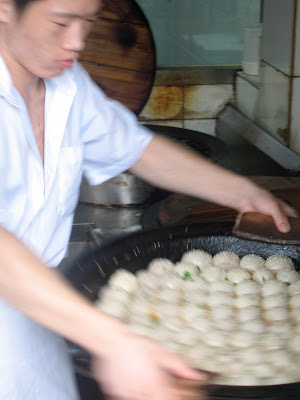
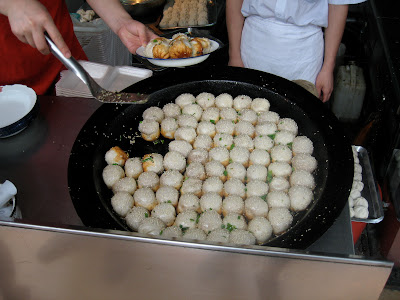
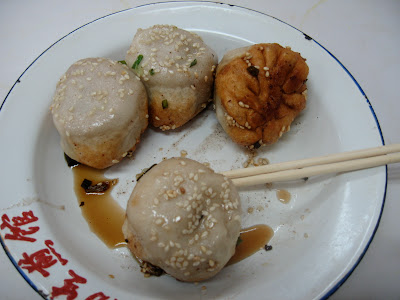
They're called Shengjian bao, (生煎包), literally translated as Raw Fried buns. Instead of simply steaming the pork filled buns, the raw buns are fried in a shallow cast-iron pan and covered with a bamboo top to capture the steam, which ends up cooking the rest of the bun. The resulting bun has an amazing crispy bottom, a soft top sprinkled with sesame seeds and chopped chives, and a filling with tons and tons of yummy juices.

The place I went to, Yang's Fry dumplings (I really don't know why they translated bao as dumplings, but every real Chinese-American knows that they're called buns), is a hole-in-the-wall place which apparently everyone in Shanghai has discovered, especially during lunch time. It has become so popular that an identical store opened right next to the original one, and there are a bunch more throughout the city.

The filling is made with little bits of gelatin that melts during the cooking process. So the resulting pork filling is actually floating in a sea of delicious juices, all held by the wrapping. I didn't know this the first time I bit into these buns, and the scorching-hot juices sprayed all over the table and my face. The fact that this little place doesn't provide napkins doesn't help the matter at all. As I discovered later, the right way to eat a fried bun to actually to first bite a small hole and suck all the juices out. Then dip it in vinegar and finally gobble it up. Yang's sell four for 4 yuan. Best lunch ever? Definitely.


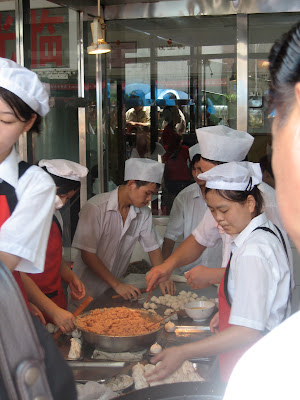
These buns take an assembly line to make: one to roll out a whole strip of dough, two to roll out round skins, and two to fill the skins with a pork filling.


The buns are fried in these really really big pans.


Check out their golden and delicious crispy bottoms


Dip them in a vinegar and chili sauce = most amazing thing ever.


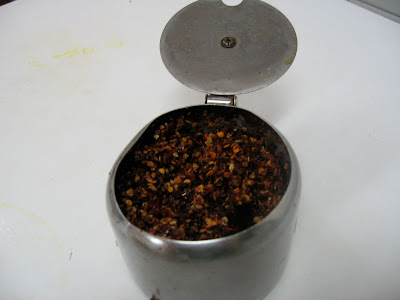
Every table needs a large pot of chili to keep the customers happy.


Definitely check this place out if you're ever in Shanghai. Yang's Fry Dumplings on Wujiang Road.